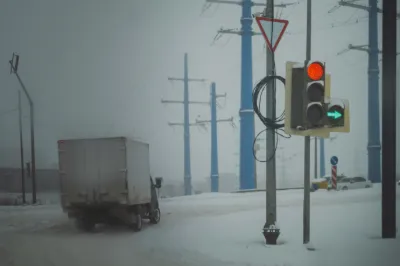
Why Winter Hits Fleets Harder Than Any Other Season
Cold weather doesn't just make driving harder, it exposes every weak point that summer conditions tend to paper over.
- Batteries fail at low temperatures. Cold cranking amps drop as the temperature drops, and a battery that seemed fine in September can leave a technician stranded in December.
- Maintenance windows get missed. Vehicles sit parked longer, get used less regularly, or get handed between drivers, and without automated tracking, service intervals quietly slip.
- Roads close or turn hazardous with barely any warning. A dispatcher without live location and route data can't reroute a driver around black ice, a closed pass or an accident quickly enough.
- Driving behaviour changes the risk profile. Harsh braking or acceleration on winter icy roads raises both accident risk and wear on the vehicle, and none of it is visible unless someone's actually measuring it.
- Compliance doesn't pause for the weather. Driver hours, tachograph data and site time recording still need to be right, even when a driver's snowed in or a site's temporarily out of reach.
None of this gets fixed by telling drivers to be more careful. It gets fixed by having data that flags, before it turns into a problem, that a battery's degrading, a service is overdue, a road's blocked, or a driver's getting close to a compliance limit.
Telematics Tips for Winter Fleet Readiness
1. Automate maintenance alerts before the cold hits
The single most useful step is also the easiest: get the system to flag maintenance deadlines instead of relying on someone remembering, or a spreadsheet nobody's opened since August. A decent telematics platform tracks inspection dates, service intervals, and the checks that matter most going into winter, things like a battery load test, antifreeze concentration, tyre tread depth, winter tyres being fitted, and sends an alert before the deadline rather than after a vehicle's already let someone down on the road.
Worth running a fleet wide maintenance report in late September or early October, before the first proper cold snap hits. That way the winterising work happens during normal hours instead of turning into an emergency repair job in January.
2. Use OBD and CAN bus data to catch battery and engine issues early
Cold weather breakdowns rarely come out of nowhere. Usually they're the end of a slow decline that OBD and CAN bus readouts can inform - predictive maintenance - before it becomes visible on the road. Voltage trends, fuel consumption creeping up, operating hours, engine diagnostics, all of it shifts measurably before a vehicle actually fails to start. Reading that straight from the vehicle's electronics, rather than waiting for a driver to notice something's off, is what turns a winter breakdown into a scheduled repair instead of an early morning phone call.
The same logic applies to mixed fleets. Whatever flags a failing van battery can just as easily flag odd vibration or load readings on an excavator sitting idle over a winter shutdown.
This is where a modular telematics platform such as AREALCONTROL comes into play: vehicle diagnostics via OBD or CAN, maintenance alerts, GPS tracking, geofencing and operational workflows can be combined within one system. The ArealPilot 360° app extends this environment to drivers and field staff.
3. Give dispatchers live visibility, not yesterday's map
Road conditions in winter can change within the hour. A live map of every vehicle, machine and asset means a dispatcher can see exactly where a vehicle is the moment a road closes, reroute a driver before they hit a hazard, and give a customer a real ETA instead of a guess. For anyone running route optimisation or a transport management system, that's even more useful: winter delays get factored into decisions as they happen rather than discovered once a driver's already stuck somewhere.
4. Set up geofencing and TimeFencing for hazardous or restricted areas
Geofencing means drawing a virtual boundary around a mountain pass, a site with limited winter access, or a depot, and getting an alert the second a vehicle crosses it. TimeFencing adds a schedule on top, handy for catching vehicles moving outside their usual working hours, which happens more in winter when shorter daylight pushes jobs earlier or later than normal.
5. Monitor driving behaviour on icy and wet roads
Harsh braking, sharp acceleration, speeding, all of it matters more once the roads turn icy, both for safety and for how fast brakes, tyres and suspension wear out. Behaviour data shows which drivers or routes need attention, whether that's a word with a driver, a different route, or a vehicle check, before something happens rather than after.
6. Keep the electronic logbook and tachograph data current, remotely
Winter makes it harder to physically get to vehicles: shorter days, remote sites, vehicles left parked outside a driver's house overnight. A GDPR compliant electronic logbook and remote tachograph download mean the compliance data keeps coming in without anyone having to trek out to a cold vehicle to pull a card or fill in a form by hand.
7. Don't forget cold chain monitoring for trailers
For fleets carrying temperature sensitive goods, winter cuts both ways, cargo can freeze just as easily as it overheats in summer. Continuous temperature monitoring with an alert the moment a reading drifts protects the load and gives you a record to point to if a customer ever questions the condition of a delivery.
8. Track fuel and idle time, cold starts add up
Idling to warm up an engine or a cab is normal in winter, and it adds up fast across a whole fleet. Breaking fuel data down by vehicle and by idle versus driving time makes it possible to set a sensible idle policy and spot the vehicles burning noticeably more than the rest, which is often an early sign of an engine or sensor problem rather than just the cold.
9. Match the right vehicle to the right job with pool fleet booking
Not every vehicle in a mixed fleet is ready for winter on the same day, some might still need winter tyres, a heater checked, or four wheel drive tested. A tracking tool with driver ID lets a dispatcher put winter ready vehicles on the routes that need them, rather than finding out about the gap once someone's already halfway there.
Winter Fleet Checklist
- Pull a fleet wide maintenance and inspection report, and get any overdue winter checks booked in before the first freeze.
- Set battery voltage and engine diagnostic alerts through OBD and CAN bus monitoring.
- Confirm winter tyres are fitted and logged per vehicle, with booking status visible to dispatchers.
- Set up geofences around known hazardous routes, restricted winter access sites and depots.
- Review driver behaviour thresholds for winter conditions, including harsh braking and speeding.
- Check the electronic logbook and tachograph download are working for every remote or rarely visited vehicle.
- Check temperature monitoring calibration on any cold chain trailers before peak winter shipping.
- Set idle time and fuel consumption baselines to catch cold weather waste early.
- Test route optimisation and live dispatching with a simulated road closure.